This week, I helped a senior brainstorm her “Why this major?” supplemental essay. She's applying undecided, so we dug into her reasoning.
She told me about the first week of school her freshman year. One of her teachers stood up and said: By now, you should know what you want to do for a career. If you don't, you're already behind.
Then she moved on.
My student looked around. All her classmates were nodding, like they had the next eight years completely figured out. She was 14, thinking about getting enough credits to graduate, keeping a high enough GPA, and in the short term, taking care of whatever was due Friday.
The career she’d step into at 22 wasn't low on the list; it wasn't even on her list.
Fast forward to today.
She’s decided to apply to a college that would support her with a little time to figure out what her career (and major) focus will be through structured exploration, regular conversations with a counselor, and time to research specific areas.
I recently talked with Jen Rolls, a friend and academic life coach who spends her days mentoring teens trying to figure out what on earth to study. Or the twenty-somethings who already have a degree but no idea what to do with it or what’s next.
We got to talking about all the doom in the air right now, the version of the story that's everywhere in the public narrative: how AI is coming for jobs and how the ROI of a college degree may not be what it once was.
Jen doesn't argue with it, exactly. Her answer is "yes, and."
Yes, the follow-the-path-we-all-followed is gone (or fading fast): Pick a major at eighteen, land the job it points to, do that one thing until you retire.
And, she said, the good news is hiding inside it.
When there's no single track left to march down, kids start building their own. She sees it all the time. A hobby that turns into a real living. A kid who builds a following around something they love, and then collects a paycheck out of it.
A friend of one of my daughter's is a perfect example of this. Maya started college with a Poshmark store where she resold thrifted clothes and, by the time she graduated from Alabama last year, had a team of six. She now runs retreats around the world for health- and wellness-minded 20-somethings, among other things.
My old boss told families a dozen years ago that the jobs our kids would grow up to do didn't exist yet. Now, that's only more true; AND teens are the ones inventing many of these jobs. One of my former students was less than a year into his first job out of college. The CEO heard how he was using AI and flew the young man to Dallas to present to the C-suite of his international company, even offering him a new role within the entire organization.
So your teen isn't behind. If anything, that freshman-year teacher had it backwards (all while spewing the one-sided, “gloom” perspective).
The point Jen made again and again as we talked is that the problem isn't the kid who can't answer "what do you want to do?" It's demanding the answer at all of a 14, 16, or 18-year-old, on command, without giving them a map or help — and calling it their job to already know.
There's a better way.
The major is the last question, not the first
By the time a family comes into my world, the major is typically settled, there's a list of schools built around it, and the topic is treated as closed.
But over the years, I’ve learned a chosen major is written in sand, not stone. A large share of students change it, plenty of them more than once. And even the most certain-sounding kid — the one who says "I'm definitely going into psychology" — I’ve learned to hold her certainty loosely.
And this is how it should be. She's 17, and things will most likely shift. What feels locked in October can look completely different next April or a year into college.
I love how Kristin Clark, a career coach friend I also talked with, approaches this.
Kristin doesn't start with the major. She doesn't even start with the career. She starts with the kid.
She teaches a six-week class. The first half goes to a single question: who is this kid? Not "what careers are out there," not "which major" — but who are they?
What do they keep talking about?
What lights them up?
Would they rather work with their hands or sit at a desk — around people all day, or heads-down on their own?
The second half matches what she learns to careers that actually fit — their interests, their skills, their strengths. The major? It's the very last thing, and it gets about ten minutes. By then, she said, it's so easy. There are two or three obvious choices. Every. Single. Time. "And that's because we did the right work first."
"What's your major?" is really just the grown-up version of a question we've asked kids since they were five: “What do you want to be when you grow up?”
We point kids at the finish line their whole lives — and less frequently at the questions that help them experiment, explore, and discover.
Kristin works it in order: the teen first, then the kind of work that fits them, then the major. Reach it that way, and it isn't a guess in the dark. It's just their next obvious step.
How to build a foundation first
A neighborhood mom confided in me recently. She was worried about her daughter, a sophomore who still can't name a single thing she wants to do. They'd talked through half a dozen careers. She’d gotten six shrugs.
"I think she'd be happy doing nails and walking dogs," the mom said.
I didn't think that was a problem. I thought it was a clue.
I told the mom: Even if you don't start until January, you have four or five months before school lets out. Each month, have your daughter pick a single thing to explore.
One month, she could talk to a nail tech about what she likes most about the job. The next, shadow a ballet school owner. The next, help her set up a Rover account and take on a few neighborhood dogs herself. That way, by June, she's tried four or five things — not just thought about them. And no plan is required up front — let her pick what comes next each month, and one thing leads to the next organically.
Jen said it best: so many kids are already scrolling a couple hours a day. Why not make it intentional? Point the feed at something real, and the algorithm hands back more than they went looking for: The teen who turned press-on nails into an Etsy shop. The dog walker who transitioned and became a trainer. The dancer/artist in New York whose whole career is hand-tinting ballet shoes.
Point your teen at the big thing first
My middle daughter started at Appalachian State with a direction, not a destination: she wanted something in science, probably to be a PA.
Freshman year, she took a required class for science students.
Five minutes into the 30th and final career video, she messaged her counselor to ask how to shadow someone in orthotics and prosthetics. It was a career she’d never heard of.
When she started college, she didn't need the full picture. She got pointed at science — and the exposure did the rest.
This was the kid who grew up building with Legos and assembling super-complex jigsaw puzzles. At one of her first jobs — a brand-new store, in the month before it opened — she quickly became the one who happily built every display, to her coworkers' relief.
Zoe had heard of a PA, and that was the closest match to what she thought she'd like doing. But when she discovered O&P as a career, it felt like a match made in heaven.
Today she's in her second year of grad school, building prosthetic devices with her own hands. Last year, she helped build a prosthetic leg for a ten-year-old born with only one — and she was in the room the day that girl took her first step. Ever.
The work is hard…and she's finding it so deeply satisfying, knowing she's on course for an amazing career that's a true match to her science interests and love of working with her hands. Well, at least most of the time.
A classmate caught Zoe moments after a plaster explosion. Love this pic of my girl. :)
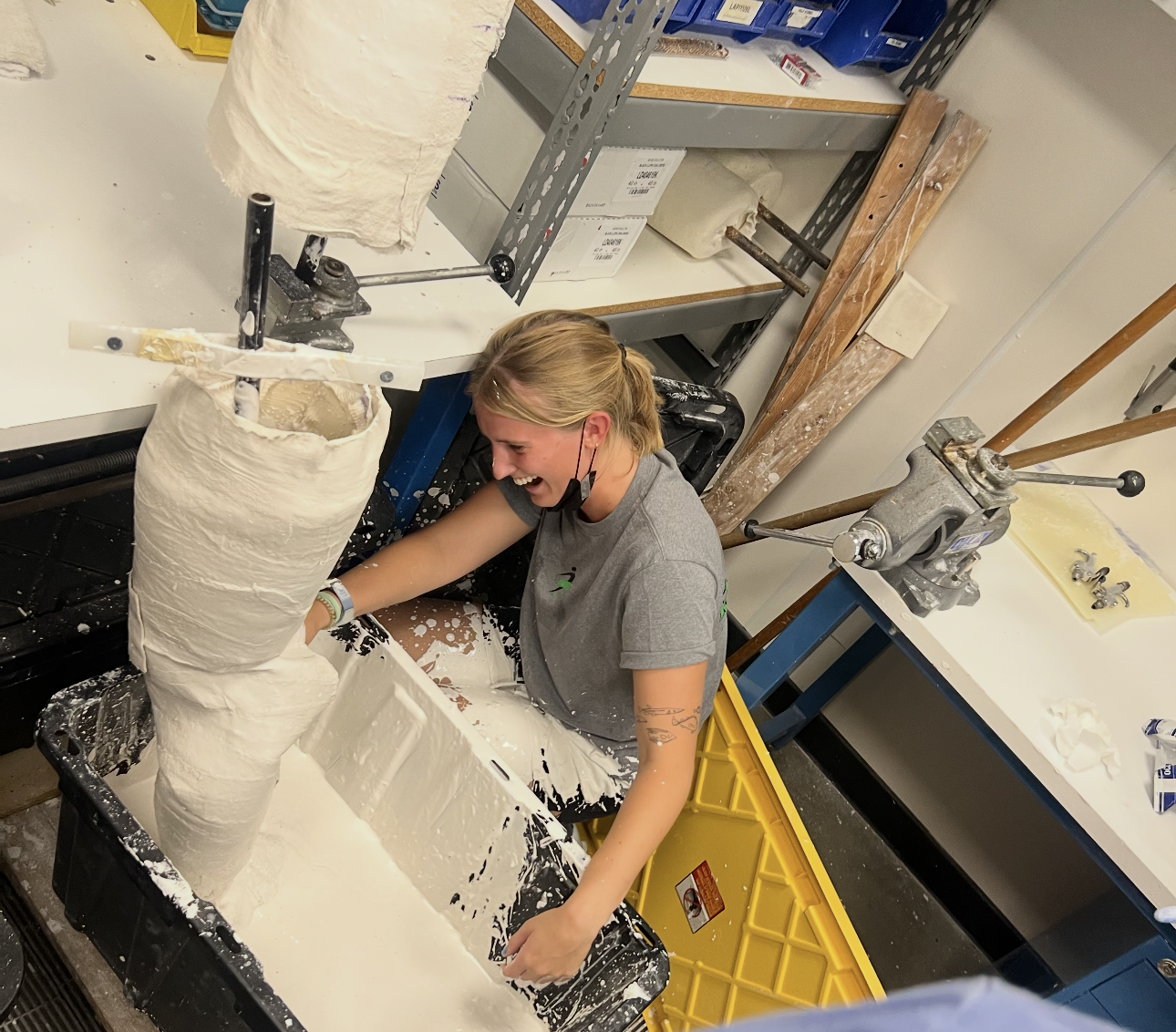
A classmate caught Zoe moments after a plaster explosion. Love this pic of my girl. :)
What to do when your teen thinks your IQ is half of what it is
So where do you fit in all of this? My old boss had a line he gave parents: "Your kid thinks your IQ is half of what it really is. And they won't see it any other way until they have kids of their own — then they'll swing to deciding it's double.”
Jen named the why of it: a teen’s job, right now, is to pull away from their parents and to find their own footing. So they tune you out, even when you're dead right. It's not a character flaw. It's biology, right on schedule — and if you've noticed it, join the club.
Which is exactly why your job isn't to hand them the answer. It's to open doors to real experiences and to bring in trustworthy voices: a coach, a counselor, the aunt who does the exact thing they're curious about.
And when your teen panics that they'll choose wrong — or that they still don't know — here's the line I'd hand them, straight from Kristin:
"You're dating this career. You're not marrying it."
If it doesn't fit, you can switch. It was always an experiment. That isn't the system failing. That's the system working.
So pick one thing. Not the whole map — just one thing. This month if you've got the room, after the holidays if you don't. Then let them go try it on. Let them drive, really drive, while you ride in the passenger seat. The not-knowing was never the problem. It's the opening.
A huge thank you to the two coaches who helped shape this issue. If your teen could use a guide who isn't you, I encourage you to reach out to either of these amazing women:
Jen Rolls, academic life coach, schedule a 20-minute complimentary session at yournextmovecoach.com
Kristin Clark, career exploration coach, schedule a 15-minute complimentary session at kristinclark.com or call her at 214.207.5887.
And tell her I sent you. :-)