
The sticker price is fiction
Last essay, we broke every college list into three fits — academic, financial, and family. (Missed it? [Read it here →])
This week, one of them takes the whole stage: the money.
Back in 2000, my family moved cross-country, from the DC area to the Chicago suburbs. When it came time to buy, I gave the agent our top price and four suburbs near my husband's work. We drove around for weeks. I looked at over a hundred houses, at least from the curb — and nothing spoke to me.
Then one day I turned down a side street by a park, and half a block down, a for-sale sign sat in front of the most charming (red!) house on the block. I called the agent: why isn't this one on my list? Because, he said, it was priced $2,000 over the top of my range.

I asked to see it anyway. I’d bet a lot of house-hunters thought the layout was way too quirky. But to me, it was perfection and checked every important box on my “must-have” list.
We negotiated, landed well inside my budget, and lived there happily for years. That home was a perfect fit — and I almost never saw it, because of a budget cap I'd set, forgetting that some things are negotiable.
I'd love to save you from making that same mistake with colleges.

The sticker price is fiction
Across the U.S., there are 428 colleges where not a single freshman pays full price. Not one.
And yet nearly 80% of families cross schools off their list because that sticker price on the website looks too high (that's Sallie Mae's figure). Maybe they don't know discounting exists. Or they know, but still keep the top of their search a little too tight (like I did in my housing search).
So let's break down the two assumptions that do the most damage.
"State schools are affordable." Sometimes. But cross from North Carolina into Virginia and in-state tuition there runs almost $24,000 a year, before room and board. In-state doesn't automatically mean best price. (And your teen can pay a different price by major at the same school — at the University of Illinois, history is about $18,000 a year; business, engineering, or computer science jumps to $23,400.)
"Private schools are for the rich." Even the brand names are cutting deals. This summer, Boston University and Rice both went tuition-free for families earning up to $200,000 — no loans, and some paying nothing for things like room and board if under $75,000. Closer to home, Vanderbilt covers full tuition up to $150,000, and Duke does the same for NC and SC families.
I think of it this way. College pricing works a lot like airline tickets: two students can land at the same school having paid wildly different fares. So don't cross a college off for its published price until you have a clearer picture of the price for your family.
Merit aid doesn't care what you earn
If your family earns well into six figures, you've probably already crossed "financial aid" off in your head. That’s fair, IF you’re talking about need-based aid.
But there’s a second type of discount, called “merit aid.” Merit scholarships reward the student — grades, test scores, a talent (athletics included) — and they don't look at your income at all. A school that wants your teen will discount its price to land them, whether you make $90,000 or $290,000. That's how a "too expensive" school can end up cheaper than an in-state option.
Just don't bank on the athletic version: full-ride sports scholarships go to less than 1% of high school athletes, and only a handful of sports offer them at all. Academic merit is the surer bet at the private and selective schools your teen is likely eyeing: about 1 in 4 students get a merit scholarship.
So before you rule a school out as "too expensive for us," look into its merit picture. Start with a quick search: "[school name] merit scholarships." Some schools even publish a grid — if a student hits a certain GPA and test score, a set award is automatic, no essay required.
Fees, and the four-year aid question
And here's the gotcha that hides even inside "in-state": fees. For a decade now, they've been the fastest-growing line on the bill — public and private both. Think of a balloon: 30 states have capped how fast tuition can rise, so schools squeeze that end, and fees balloon out the other. A technology fee, an athletic fee (yes, you help fund teams your teen may never watch), a rec-center fee, a transportation fee — together they can add as much as 27% on top of tuition. My daughter's in-state tuition at UNC Charlotte doesn't include the $1,200 in fees on her bill this semester.
And the single most useful question you can ask any school: "Is this aid package guaranteed for all four years?" Because aid routinely shrinks after freshman year, and you can get stuck with a bill far bigger than you planned for. Some schools — the University of Dayton, for one — lock your net price for all four years. That question alone can be worth tens of thousands in savings.
The community-college route
Community college for the first two years can cut the cost of a degree dramatically. Free community college is now the reality in two-thirds of states.
Some places go further. Near where I lived in Illinois, the College of DuPage runs a "3+1." A student spends three years on the community-college campus. In year four, a partner university teaches right there, at a steep discount. The payoff? That student gets a nursing degree from Benedictine University for about $33,000. The same degree over four years at Benedictine costs more than $137,000.
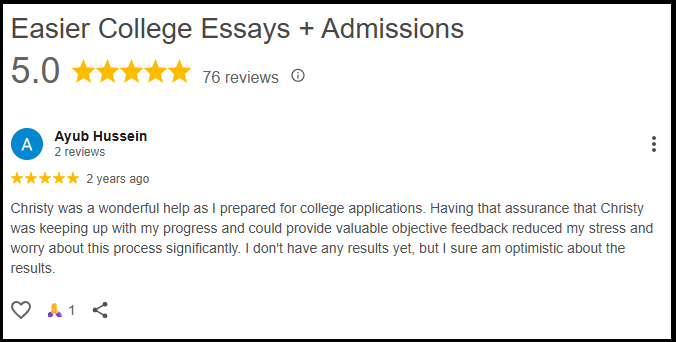
I think of Ayub, who called me for essay help after two years of community college. He hoped to transfer to his number-one choice school, NC State. Ayub was first-gen, one of seven kids, with immigrant parents. He paid me from his grocery-store wages. We worked every essay together, and he got in — with a full ride. (And in his case, I’d bet it was both merit AND need-based aid.) Community college wasn't a step down for Ayub. It was the smart way in.
When it's worth paying more
Sophia wanted to study sports journalism — specifically, to cover hockey. Two Catholic colleges she applied to offered her $124,000 and $127,000. Either would've made her decision easy.
Boston College — also Jesuit Catholic — was still her #1 choice because she liked the area and had family living nearby. As I helped her research it further, we discovered a strong sports journalism program and Division I hockey team. For a young woman who wanted to cover hockey, that wasn't a bonus. That was the program built for the exact future she wanted.
Her parents didn't agonize over money versus feelings. They said: we have one child, we've worked our whole careers, we're doing this, even if our daughter doesn’t get as much merit money.
They didn’t ignore the money, and knew to the dollar, what they were choosing, for reasons they could say out loud. For this school and this family, money was a lower priority fit than major and area. Their story the opposite of falling for a school and skipping the numbers altogether.
The winning fit is one you pick.
Have the money talk early—and often
Years ago, working under Michael McKinnon at his college-planning firm, I watched a mom and dad sit down across his desk. Their daughter had a dream school, they'd already told the school she was coming, and now they wanted help paying for it. Michael had to give them the hard truth: they'd come to the money conversation too late.
Something he said has stuck with me: some parents simply cannot say no to their kids. And if you know, deep down, that's you — the plan has to change. So start early. And don't make it a dreaded, one-time talk. Say the numbers out loud, and keep saying them:
"We can try for this school. We don't know yet what scholarships might come. But if they don't, you're not going there."
I lived the healthy version with my youngest. We thought she had a real shot at a scholarship that would've made a small private college — a beautiful fit — affordable. It didn't come through. And there was no crisis, because we'd been talking about the numbers all along. We simply switched her acceptance to a school we could afford. No drama — because we had a clear Plan B.
Know that the offer isn't final
Switching schools, like we did with my youngest, is one option. But it's not the only one. Before you walk away from a school your teen really wants, it can be worth talking with the Financial Aid office — because the number in an acceptance letter isn't fixed. It's an offer. And an offer is the start of a conversation.
My friend Dottie's son got into his top school — where he wanted to play hockey — but the offer was more than the family could swing. So she asked, plainly, "What can you do?" They came back with a lower number. Still too high. "Can you help me more?" she asked. This time they flipped it: "What do you need it to be?" She named a specific figure — not wildly lower, but lower enough for her — and they said yes.
Schools rarely lead with their lowest number (that’s smart business, after all). So don't take the first offer as the ceiling. Sometimes the eyeball-to-eyeball conversation in the Financial Aid office is the one that moves the needle from dream school to reality.
WHAT DOESN'T MATTERS
► The sticker price
It’s almost make-believe. Judge a school by its net price, not the number on the website.
► The assumptions you walked in with
“That college always costs a fortune,“ that “state schools are automatically the cheap choice,” and that “private schools are only for the rich” — this whole essay is one exception after another. Hold those inherited beliefs loosely. Know there are exceptions, and that they might just swing in your favor.
► What the family down the street got
Their kid's scholarship might be merit, might be need-based — and you probably can't tell which from the outside. Their GPA, their activities, their finances aren't your teen's. So let a neighbor's outcome nudge you to go look, but not convince you the same thing will happen. Don't take anyone else’s experience as gospel.
WHAT MATTERS
► The net price
Not the sticker — the real number after aid and merit. It can land tens of thousands below the published price. And ask whether it's locked for all four years, since aid often shrinks after freshman year.
► Merit aid
It doesn't depend on what your family earns, and it's the surest discount for a strong student. Look up a school's merit scholarships before you rule it out for cost.
► File the FAFSA
(and the CSS Profile, where required) even if you're sure you won't qualify. At many schools, the FAFSA is not just for need-based aid: it’s the gate to merit money too.
► The money conversations
Start them early, and keep having them. When the numbers are on the table all along, a scholarship that doesn't come through becomes a pivot, not a crisis. And you're building a habit, not checking a box — the money conversations don't stop at the acceptance letter. There will be plenty more over the next four years.
Your move this week
If you haven't yet, download the Build Your College List with AI guide. It’s free, and designed to run these numbers alongside you all season.
Then say your real top number out loud, and let your teen hear it. Not as a hard ceiling, but as a clear starting point.
With love, clear eyes on the real cost, and faith a great school for your teen is within reach,
Christy
Your go-to college essay + admissions mentor