

College Curveballs
In last month’s newsletter, I talked about the “Senior Year Shift” — that very normal, slightly whiplash-inducing moment when a teen who sounded absolutely sure about their dream school in junior year suddenly grows into a different version of themselves by the end of senior year.
After I sent that off, my inbox lit up.
Not just with stories about changed minds, but all the other things — the stuff that happened after move-in day that families hadn’t expected…
Programs that looked incredible and delivered much less than expected. Campus cultures that felt like landing on Mars. Roommate situations that deserved their own true crime podcast and teens who wanted to pack up and come home by Week 3.
And so, let’s talk about this part of the college process more — not to scare anyone, but because the “right” college is about far more than a sweatshirt, a ranking, or a great tour guide on a sunny afternoon in May.
So whether you’re parenting a senior about to launch, a junior gearing up to apply this summer and fall, or a younger teen who still thinks this is all “future future” territory… I hope today’s conversation will really help your family.
🗺️
When the Program
Looks Better on Paper
One parent wrote to me about a student I’ll call Ben, who chose a small New England college partly because of its co-op offering (a program where students alternate semesters of coursework with paid, real-world work experience).
On the tour and on paper, it sounded perfect.
Ben was brilliant but had some special needs, and the co-op structure would help him build confidence, get work experience, and transition into the professional world with plenty of support and guidance. That was one of the big reasons he chose the school.
Then he got there.
And pretty quickly, the gap between the brochure version and the lived version started showing.

The school was small. The resources were limited. The support systems sounded strong during admissions conversations, but once he was on campus, there wasn’t much follow-through or structure around helping him as a student actually navigate the process.
An attractive college feature is only valuable if your teen can actually access it.
A co-op program. An honors college. A career center. A research opportunity. Disability services. A “supportive community.”
Those phrases can mean a dedicated person who helps your teen make a plan, follows up when they go quiet, and notices when something is off.
Or…they can mean a portal, three tabs, a password reset button.
These are not the same experience. Not even distant cousins, especially for teens who need structure, accountability, executive functioning support, emotional encouragement, or a trusted adult on campus who will notice when they’re struggling before things completely unravel.
Some teens chase opportunities like golden retrievers after tennis balls. Others need the opportunity to come with a map, a point person, and someone who checks in along the way.
Know which one yours is. Then verify — before that first deposit is paid — that the school actually delivers what will most help your teen thrive.
🌎
When the School Culture Feels Like Another Country
Another student, Lily, wanted to go far, far away from everyone she knew in the Midwest. She had a vision that involved a fresh start, hiking in the mountains, and a highly respected pre-vet program.
At the same time, her plan also felt safer because one of her closest friends was already at the college she’d chosen. Knowing at least one person on campus made such a huge leap feel less terrifying.
But then freshman year began.
Her Bestie got serious with a boyfriend almost immediately and basically vanished into her already-established life. At one point, Lily said her friend literally walked past her on campus and looked the other way.
Meanwhile, the campus culture Lily had never really examined turned out to be a massive surprise.
Roughly 70% of the students at her school were part of the LDS (Mormon) church community. Many had recently returned from missions or were preparing to leave for one. Church life shaped the social rhythm of campus far more than Lily expected at a big, public D1 football school.

Her roommate wore temple garments under her modest long skirts. Large groups of students headed to temple together weekly, and Lily quickly realized many of the girls she started freshman year with were there for their “Mrs. Degree” and likely wouldn’t be back sophomore year because they’d gotten married.
This wasn’t just “people do things differently here.”
It felt more like Lily had accidentally enrolled in a cultural exchange program she hadn’t realized she signed up for because she’d been so focused on the pre-vet program and the comfort of knowing one familiar person.
Everything felt different:
How people socialized.
How religion shaped friendships.
How students talked about marriage, family, and the future.
For some students, that environment would feel deeply comforting and aligned.
But not for Lily.
She became depressed. She called her mom daily — sometimes two or three times a day — completely overwhelmed. She failed a brutal introductory science weed-out course. And by the end of first semester, her family moved her home.
Suddenly, she was back at Square One: New applications. New decisions. New logistics. And sadly, no longer starting with the same scholarship opportunities she had the first time around.
And this is the part families can miss when a college decision becomes too centered around another person…
Yes, a familiar face matters. Yes, friendships can soften the landing.
But a friend is not a foundation for the school decision. People’s lives change fast at 18.
The school itself has to work. The culture. The academic pressure. The social environment. The distance from home.
Because the version your teen lives is what counts.
✨
When the Rug Gets
Pulled Out
Now let’s talk about my daughter, Zoe.
She didn’t transfer schools, but her first year gave me a front-row seat to a different kind of college curveball: the social rug-pull.
Zoe likes things structured, predictable, and drama-free. She worked hard to find the perfect roommate as soon as the freshman portal opened, found someone she clicked with who matched up to everything on her “must have/not have” lists, and moved in, feeling like the plan was perfect.
Then her roommate moved out in the night, literally, two weeks later, for medical reasons. A month later, a new roommate moved in, and within days, the warning signs appeared. There were serious mental health concerns with this young lady and hygiene issues — including food left out so long that mold was growing on it — that left the space feeling stressful, unhealthy, and impossible for Zoe, a self-professed germaphobe. This was way beyond “just adjust” territory. And, no, campus services wouldn’t do anything, even after repeated calls.
Eventually, Zoe made the hard decision to move rooms. It wasn’t a school transfer, but still a transfer of sorts: an on-campus, living-situation transfer.
She ended up in a better dorm, which helped. But even this roommate came with challenges (hint: there’s a reason the other bed in her room was now vacant and available).
Look, college can rearrange your teen’s social world fast. Roommates leave. Friend groups shift. People transfer or drop out. And sometimes the college experience your teen imagined gets replaced by something they did not expect.
Essentially, freshman year can be the world’s most expensive mystery box.
Zoe’s outcome was happy because the school itself was right. The roommate chaos was real — disruptive, stressful, the kind of thing no campus tour prepares you for. But it didn’t have the power to unravel everything, because the foundation held.
That’s what you’re actually building right now, during high school.
Not a perfect plan, but a foundation sturdy enough to hold when the plan changes.
And it will change. Here’s what that usually looks like:
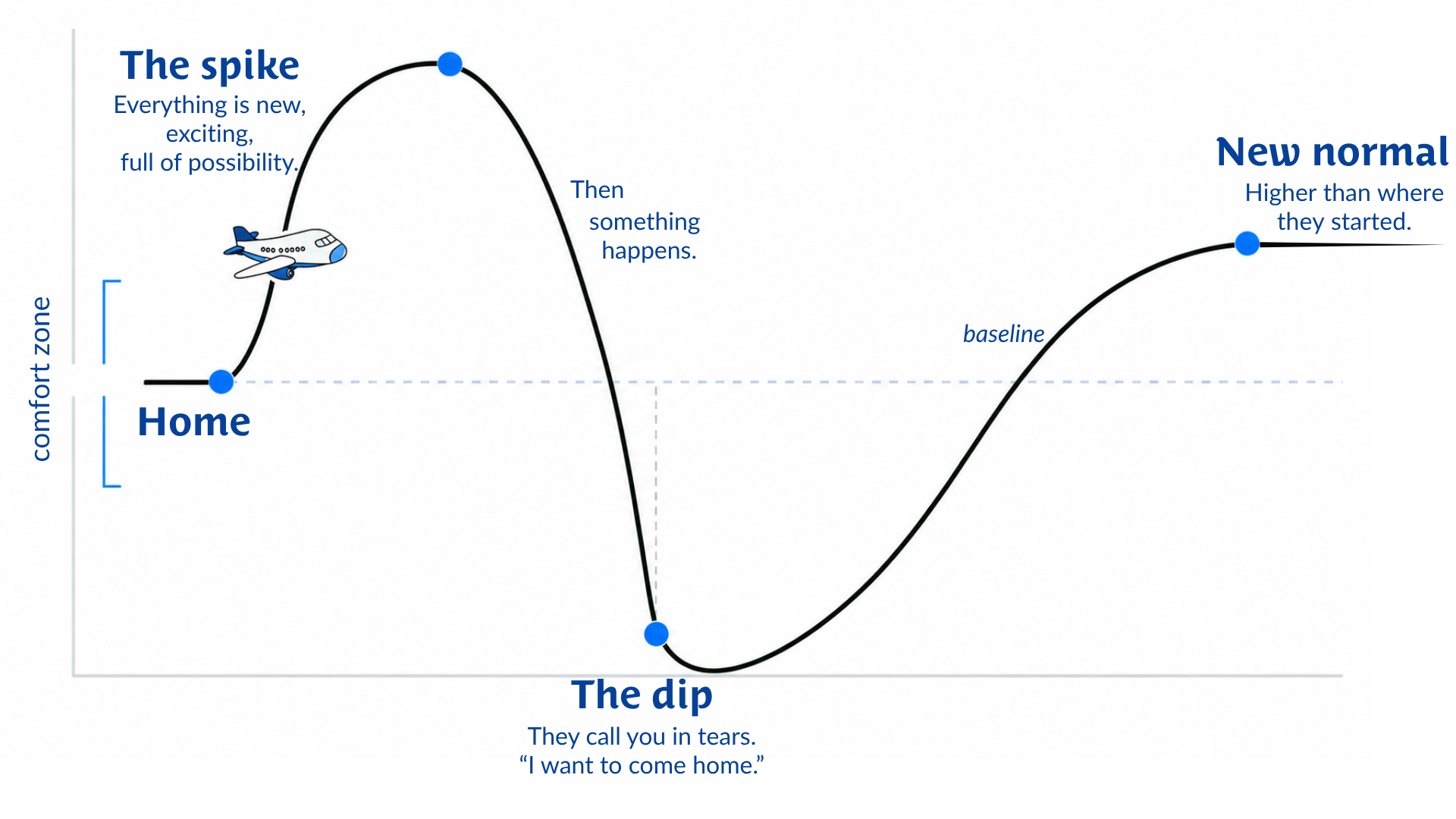
Every major transition follows a similar arc.
📉
The One Dip Every Teen Can Learn to Recognize
At some point, your teen is probably going to want to quit.
Not because something is wrong with them. Not because they chose the “wrong” school. But because huge transitions almost always come with a dip. It’s just a matter of when and how deep.
I know this firsthand. One of my first jobs out of college was with Youth for Understanding (YFU), the world’s oldest international student exchange organization. They were sending high school students around the world for six weeks, a semester, or a year at a time. And they didn’t just hand those kids a packing list before they jumped on their flights. They prepared them — with workbooks, a retreat, and one chart in particular that I’ve never forgotten.
It looked something like the one you see above.
On the left: home. Comfortable, known, familiar. Then the student gets on the plane (or in the minivan), and the line shoots up. The food at their new place is extraordinary. The architecture or environment is beautiful. Everything feels full of possibilities. It’s electric.
Then something happens. It can be so small that the student doesn't even register it. Or it can be something highly remarkable. Either way, that line — the one that shot up — now drops. Hard. And it heads far south of where they were before they ever left home.
This is where the student gets tired… Tired of being “on” around strangers every hour of the day. Tired of unfamiliar food. (I once spent my last two days in India eating lambburgers at McDonald’s in Delhi. I was just so done.) Tired of trying.
And then you get the call.
They’re in tears. "I want to come home."
That call can feel like a five-alarm emergency to a parent.
But if you and your teen have already talked about the dip, that call can land differently. You, my wise parent, can say: “This sounds like the dip we talked about. It feels awful, and we’re taking it seriously — but we’re not making a permanent decision from the bottom of the curve.”
That is a powerful sentence.

Seth Godin wrote an entire book about this moment — The Dip — and one idea has stayed with me in the 20 years since I first read it. We were all raised on “winners never quit.”
Godin’s argument is that that’s exactly backward.
Knowing when to change course — and doing it intentionally, without shame — is actually the mark of a strategic mind. Winners quit the right things at the right time.
That’s a very different story from the one most teens (heck, us adults too!) have been handed.
Yes, sometimes the answer is to stay and adjust. Change rooms. Talk to an advisor. Get tutoring. Come home for a weekend and reset. Give it more time.
And sometimes the answer really is to leave — to transfer, take a gap year, start over at a community college, or enroll as an apprentice for a trade.
There is no shame in any of those moves.
My son Mike left college. Twice. Each time he reset, got a job, and figured himself out a bit more. At 25, he finally said: “Now I’m ready.” And he’s doing great in his third school.
What most families don’t know: nearly 4 in 10 college students don’t finish their degree. About 1 in 4 freshmen don’t return for a second year. They just quietly disappear from campus — sophomore year, junior year, even sometimes senior year.
A teen who has the tools to recognize a dip, talk honestly with their parents or other trusted mentors, and make a clear-eyed decision about whether to push through or pivot — that teen is in a fundamentally different position than so many. That’s strategy in action, not a collapse.
And the tools to deal with life’s unexpected jolts don’t come from the admissions process. They come from the conversations happening at home right now.
🧭
Building the Foundation That Holds
A mentor once told me that when a spacecraft returns from the moon, it’s off course 99.995% of the time. And yet it still lands precisely on target. Not because the trajectory was perfect. But because it was adjusting — constantly, all the way back to the X that marks the spot.

That’s what parenting a college-bound teen actually looks like when it’s working. Not one defining conversation. Not always the perfect school on the first try. Micro-adjustments, again and again — fit, finances, readiness, culture, distance, support — made by a family that stays in communication all the way through.
The families who navigate this well are the ones who keep talking, who honor their instincts even when the conversation is uncomfortable, and who understand that being supportive doesn’t mean staying silent when something feels off.
None of us can prevent the unexpected parts of the college experience. But the school choice matters — a campus that actually fits your teen gives them a sturdier place to land when things get hard. And them knowing you’re in their corner, whether they’re sleeping across the hall or across the country, gives them something even a perfect school can’t.
That’s not a small thing. Think of conversations about the dip as an inoculation. You’re not predicting disaster — you’re building up the immunity so that if something hard hits, the system you’ve built already knows how to respond.
If your teen is a junior, this is the moment. There’s still room to have more conversations about what the teen wants, to adjust the list, and to make more strategic choices before the decisions solidified. I have a handful of free 20-minute consults open this month. Pop onto my calendar and let’s make sure what’s on the table truly fits your teen, the budget, and real life.
With love, better questions, and a deep respect for plot twists,
Christy Sharafinski
Your go-to college essay + admissions mentor
P.S. One book I recommend regularly is Frank Bruni’s Where You Go Is Not Who You'll Be. It loosens the grip on the idea that one school determines a child’s future.
P.P.S.Whatever schools end up on your teen’s list, they still need a personal statement essay. My Complete Your Essay in a Weekend workshop has helped hundreds of students complete theirs more quickly (and better) than they dreamed possible.
👋 Hi, if we haven’t met yet, I’m Christy. I help students craft standout essays so they can submit their best possible applications with confidence.
Wanna chat? www.calendly.com/easiercollegeessays/30min