What Actually Happens Inside An Essay Workshop
I was talking with a parent recently when she said something that made me smile.
She assumed my Complete Your Essay in a Weekend workshop worked like this:
Saturday: write the essay.
Sunday: edit the essay.
Following Friday: toss confetti, upload final version into the Common App, go eat tacos.
Which sounds perfectly logical.
Also… it's not quite that simple.
Because before a teen writes anything worth keeping, we have to deal with the sneaky little trap hijacking almost every college essay: The topic.
Not the grammar.
Not the opening line.
Not whether the conclusion needs “more reflection,” adult-speak for “please make this sound deeper without making it weird.”
The topic is what everything hinges on (but not necessarily in the way many students think. More on that later.)
Most teens come into the workshop thinking they already have a good one. Some have been mentally writing the same essay for years.(These are usually the high-achieving, slightly anxious planners who have carried this topic around since they were freshmen)
Some thought about it for a few minuteswhile driving to the workshop because they are teenagers and, yes, a few minutes working on something remotely school or college-related can feel like a research sabbatical.
And some have a bunch of half-baked ideas, reasons why now is not yet a good time to figure this out, and a sneaking suspicion that every topic they choose will be somehow wrong.
🗺️
Different starting points.
Same problem.
What’s common in all this is that most teens choose topics from a place of performance.
They’re trying to impress a faceless admissions reader sitting in some mysterious office with a coffee, a red pen, and the power to determine their future.
The problem with that strategy is that it usually produces essays that sound…well, fine.
But “fine” is NOT the goal.
Fine is the elevator music of college essays. Respectable. Functional. And forgetable.
What essays need is a topic with roots. Something sturdy enough to hold a real story, meaning, and a sense of who this teen is, when they’re not trying to sound like “college worthy.”
✨
Before Saturday:
The Digging Begins
A few days before the workshop, every teen gets access to an hour-long recorded mini-workshop.
Bad news: They need to do 12 fun micro-exercises before we meet.
Good news: No one is required to write yet. Nobody needs to outline anything or come up with a rough draft while quietly wondering if moving to a remote island would be easier than writing a personal statement.
I call this part the excavation. We’re digging for the stories they forgot (or never knew) counted.
I’m not talking about the obvious trophy stories. Nor the “I learned perseverance from sports” stories, bless their hardworking little heart. And definitely not the “I went on a service trip and it changed my life” stories either, which have been dragged through the admissions office so many times it needs a nap.
We look elsewhere, beyond the obvious (and trite), and these fun little exercises that only take a few minutes help teens do just that.
For example, one exercise uncovers what they hate, but secretly care about a lot.
This one is magic because teens suddenly remember they have opinions. Actual, fierce opinions that make them sit up straighter and say things like, “Oh! I can't stand it when...”
Yes, that. See? Now we have a pulse. And we've touched on their quirkiness and a small part of what makes them unique, interesting, and totally human.
Another exercise teases out an object from their room, along with the story behind it. But not a medal, a certificate, or the shiny thing adults already approve of.
The weird thing.
The bracelet from third grade.
The broken keychain they refuse to throw away.
The rock on the shelf that has apparently survived three moves and several parental cleaning attacks.
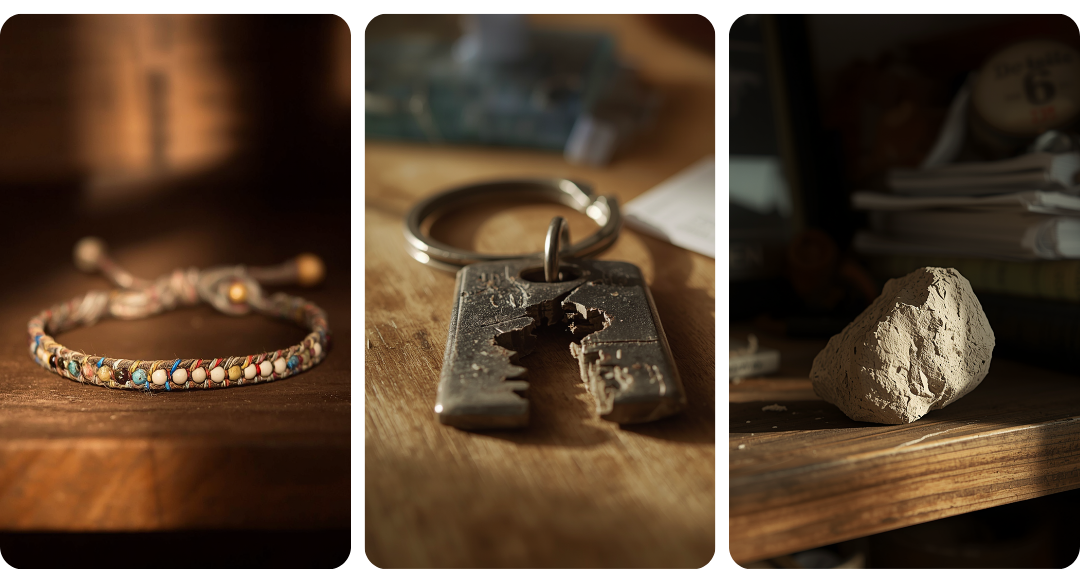
The teens always laugh at this point because they know exactly what that thing is.
And that weird little object usually has more life in it than the topic they thought they were supposed to write about.
Yet another question can unearth what they do so naturally that it seems like nothing to them, yet other people keep pointing out.
This is one of my favorites because teens are notorious for dismissing their own gifts.
They’ll say, “I don’t know. I just kind of organize everyone.”
Young Lady. That is leadership.
Or, “I just help my friends calm down when they’re freaking out.”
Hello, emotional regulator.
Or, “I just notice when systems don’t make sense.”
Congratulations, future operations consultant.
By the time Saturday morning arrives, every teen has an idea list saved somewhere.
Some ideas are decent. Some are probably not it. And some need to be escorted gently from the premises.
But more often, buried near the bottom of it all, the one appears.
✨
Saturday Morning:
Out of the Bat Cave
The first 90-minutes of the workshop are not spent writing.
Instead…

We meet in person, and I pull them out of their own heads. That’s the essential first step.
See, left to their own devices, teens spiral. They’ll debate a topic for three weeks, reject it, resurrect it, ask one friend, panic over the friend’s opinion, and then choose something worse because the deadline now smells like smoke.
But in the workshop, something different happens.
They say their ideas out loud. They hear themselves. Other teens share their stories. Details surface. New possibilities emerge. And sometimes, a topic they were clinging to since ninth grade gets retired with dignity.
Once we have enough to build on, I sit down with each teen for five minutes. Which may not sound like much, but I’ve had these conversations hundreds of times.
I can usually tell pretty quickly if the topic has legs, or if it’s about to collapse dramatically in paragraph three.
One student, LaSean, started our conversation with a few ideas.
They were decent. And boring.
Then, almost as an aside, he mentioned he had built a website, organized a photo shoot, and was selling products to customers in California.
I stopped him.
“That’s it.”
He looked genuinely stunned.
“What? I can write about that?!?”
Absolutely. Immediately. With a parade.
Because that was his story.
Not the polished thing he thought admissions wanted, but the real thing – the entrepreneurial, self-starting, problem-solving, creative thing that revealed who he actually was.
That moment repeats in one form or another in every workshop.
The teen says something they think is random. I hear “That!” They look at me like I just pulled a rabbit out of a hoodie pocket.
Most teens need someone experienced enough to say:
Not that one. (And then ask a bunch of questions.)
This one.
And this is why.
That “why” matters. Once they see what I see, their confidence grows. Their shoulders relax. Their brain stops sprinting in circles. They finally know where they’re headed.
And because no teen wants to write a single word they’d have to rewrite later, we don’t start drafting until the foundation is solid.
Otherwise, we’re just decorating what might be the wrong cake.
But once the topic is right, the writing is clearer, faster, and easier.
✨
Lunch:
The Break That Isn’t Really a Break
By lunchtime each day, these teens’ brains have worked hard.
They’ve gone back through their lives.
They’ve pulled up memories they haven’t thought about in years.
They’ve shared ideas in a room full of people who were strangers a few hours earlier.
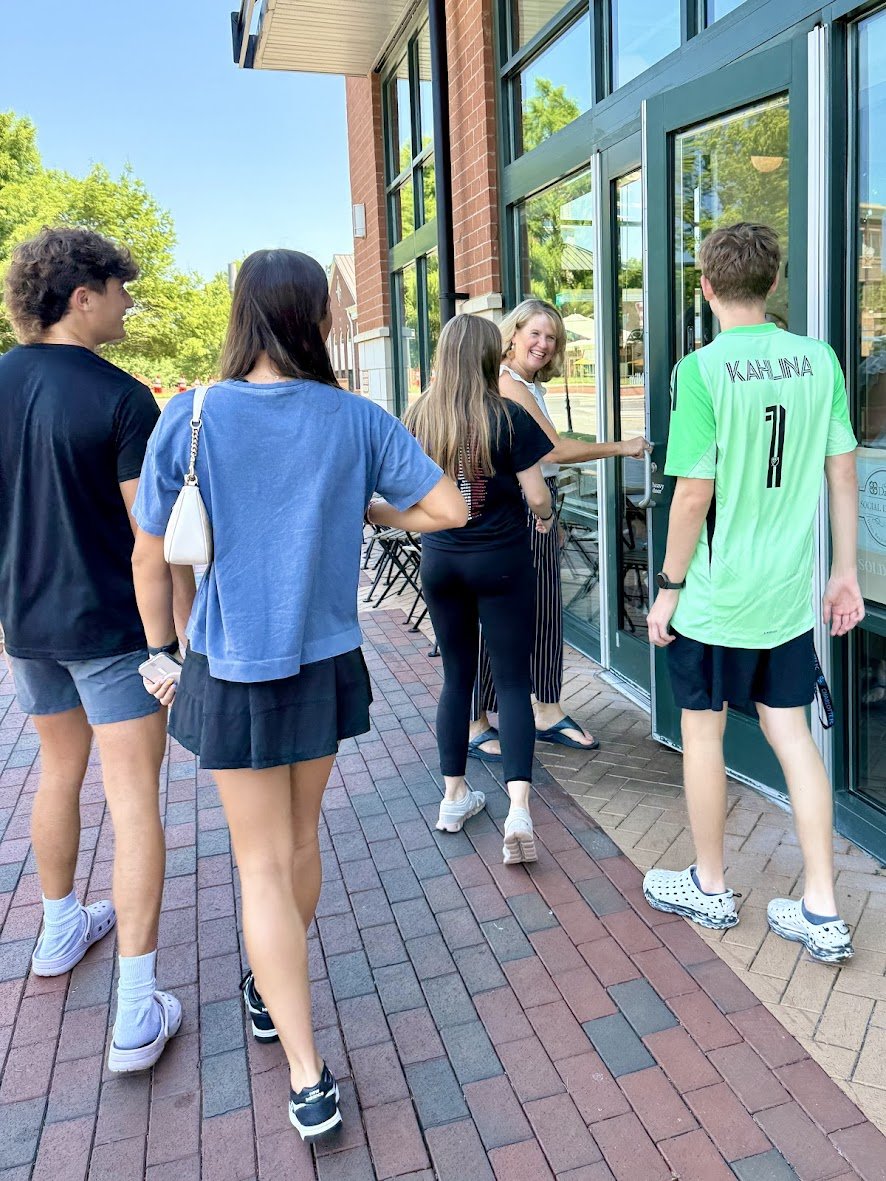
So we get in the car and head to Birkdale for a well-deserved break – CAVA usually wins.
And yes, lunch is still a session. But it’s also one of the sneaky-good parts of the whole weekend.
I’ve been to enough conferences to know that some of the best moments do not happen during the formal sessions. They happen in line for coffee. Over lunch. In that random hallway conversation where somebody says the exact thing I needed to hear.
Same here.
One teen talks through the major she’s considering and whether it actually fits the life she imagines. Another asks about a college sitting at the top of his list, but he hasn’t been brave enough to bring it up at home yet.
Test scores, school visits, gap years, roommates, distance from home, majors, scholarships, “my mom thinks…” and “my dad keeps saying…” all come up.
It’s not all work, and yet it’s not a break. It’s this lovely in-between space where the conversation becomes exactly what that particular group needs.
And then there’s the bonus social part, which I love.
One time, two of my attendees realized they both played highly competitive volleyball. They had probably been in the same orbit for years and never would have spoken off the court.
At lunch, those 6-foot-7-inch athletes connected.
I’ve watched numerous real friendships start at that table, and this matters to me.
Most teens have lived in the same circles for most of their lives. Same schools. Same friend groups. Same group chats. Sometimes for 11+ years.
College is different.
College is walking into rooms where nobody knows your history, your family, or what kind of friend you can be.
Meeting new people is a skill, and our lunch together, as low-stakes and easy as it seems, gives them a tiny practice round at meeting new people.
My lunch crew during a workshop last summer.
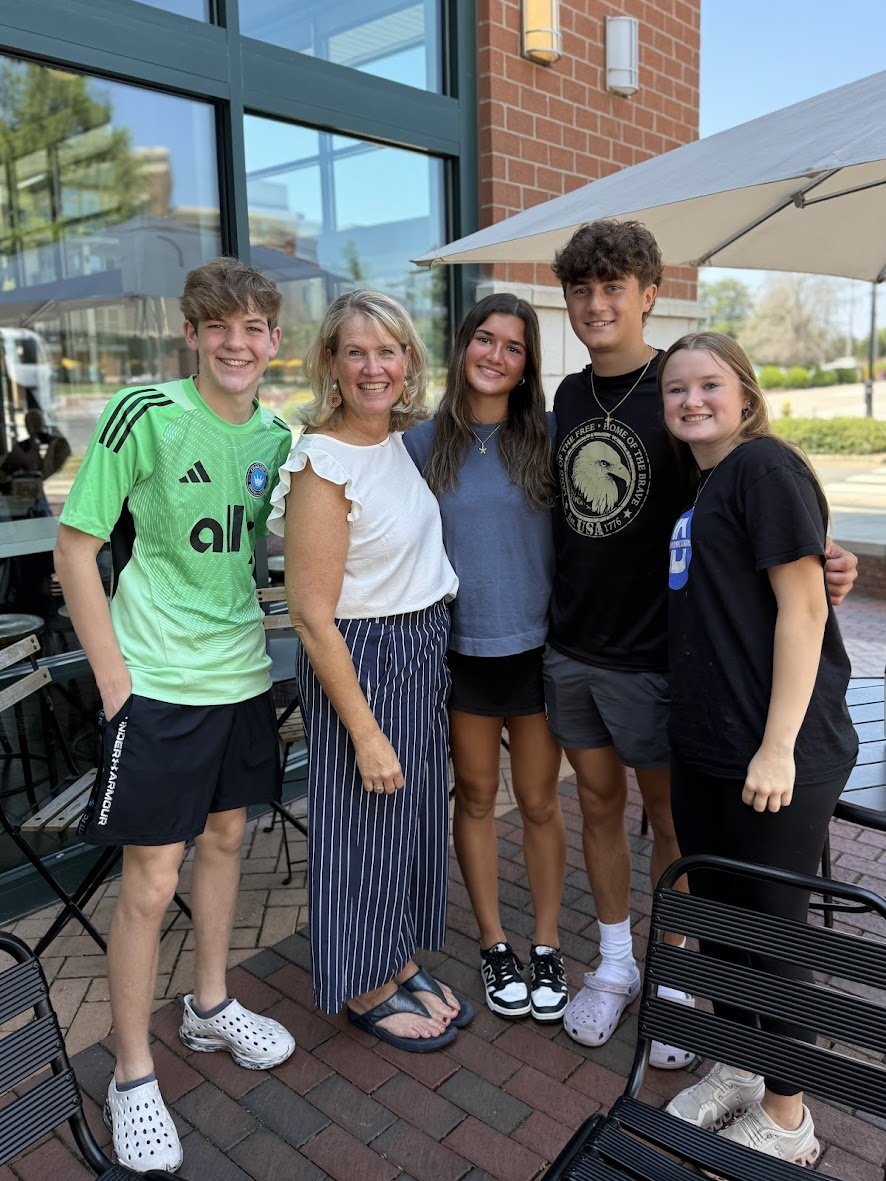
My lunch crew during a workshop last summer.
✨
Three Drafts. Not One.
When I first started doing this work, I helped teens one-on-one at an agency in Chicago.
Back then, I took whatever draft the teen brought me and helped improve it without addressing the topic. (Because that's what the “essay specialist” before me had done.)
We tightened the language. Improved the flow. I taught students how to use spell check because, yes, I've done this long enough to remember when spell check was not automatic.
It was a reliable process, and teens walked away with an improved version of what they’ve brought with them.
Then one day, Lana taught me something I needed to learn.
She handed me an essay that was beautifully written and deeply heavy.
She had written about her mentor, an internationally known author who had been almost like an aunt to her. This woman had died just a month or two earlier, and Lana was still very much inside the grief.
The essay read like a well-written cry for time with a therapist.
At that point in my career, I didn’t know I was allowed to say, “Let’s choose a different topic.”
So instead, we worked with it.
Then Lana herself came back later and said, “I think I can do better.”
And she started over. From scratch.
The second version improved. Maybe 20%. Then she said it again.
“I think I can do better.”
So she started over again. And still again.
By the fourth version, with almost no input from me other than encouragement to keep going, the essay had transformed.
It was no longer about her pain and feeling like she was drowning.
Instead, it became a story about sidewalk chalk. About an afternoon with her mentor. About this woman writing on the pavement:
> Why do they call it the present?
> Because it’s a gift.
That was the real essay. It could finally hold the grief, the love, the guilt, the memories, and the meaning. It had worked its way out of the fog and into an actual story worth telling.
I still remember that essay more than ten years later.
Lana taught me the power of starting over. Not revising what is (which I now call a “Frankenstein Essay”)… but starting over, from the beginning.
Teens working alone almost never do this.
Once they’ve spent hours on a draft, they want to keep polishing it. That makes sense. Nobody wants to toss work into the digital fireplace.
But sometimes the first draft isn’t the essay. Its work is to be the version that gets them to the real one.
That’s why about 20% of my students get a second one-on-one conversation where we revisit their topic. Because once a draft exists, some students realize they don’t have as much to say as they first thought. Or that the real story is elsewhere.
Basically, the first topic did exactly what it was supposed to do, which was free up space and lead them somewhere better.
That’s not failure. That’s the process working.
And that’s why the workshop produces three drafts before Sunday wraps. We don’t endlessly decorate the same draft like a sad cupcake.
Instead, we create three unique versions. All thanks to Lana.
✨
Sunday Afternoon:
Tired, Proud, and Slightly Crispy
By Sunday afternoon, the teens are tired.
Not “I ran a marathon” tired. More like “I just pulled meaningful stories out of my own life, learned a totally different kind of writing, and used emotional muscles I didn’t know existed,” tired.
Five 90-minute sessions in one weekend may be shorter than a school day, but the workshop asks something very different of them, which isn’t academic writing, a five-paragraph essay, a research paper, or a tidy conclusion.
They’re learning how to write in a way that reveals, holds emotion, and shows meaning without smacking the reader over the head with it.
All that, plus it still sounds like them.
I like to say that training a teen how to write the way they need to for the Personal Statement is a bit like Tiger Woods completely rebuilding his golf swing. To a teen who has spent years being rewarded one way for “school writing,” this new kind of writing can feel awkward at first.
But awkward also means they are learning something new and absolutely necessary to create an Aligned Essay.
✨
Monday Morning:
My Turn
Monday morning, I finally read the essays for the first time.
At this point, I am not hunting for commas. Commas are needed, but they can wait.
First, I’m looking for the angle:
Is the story starting in the right place?
Is the teen telling the right part of it?
Is the meaning clear enough to build on?
If the essay needs a pivot, we don’t waste time polishing sentences that may need to move, change, or disappear.
In this case, I just send a short video inside Slack. That way, the teen can hear my thinking and understand the nuance. Fast. I can say things in a way that would otherwise take 17 comments to explain inside a Google Doc.
✨
Once the story is solid,
then we edit
This is where I teach the teens to see their writing differently. This is stuff beyond what they've been taught in high school. (I know that because I poll them after I teach it to them.)
For example, one step is that I have them search the entire essay for the words “not” and “no.”
Sounds nitpicky, but it’s not.
Research shows the brain skips the word “not” and lands on whatever follows.
“I wasn’t afraid” registers as “I was afraid.”
“She wasn’t happy with me” registers as happy.
The intended meaning disappears, and the opposite lands instead. Once a student sees it, they can’t unsee it.
And they slowly find it everywhere.
Then, I ask teens to do the more important work of saying what they actually mean. And trust me, it’s hard.
“Terrified, I froze.”
“My voice shook.”
“I wanted to disappear behind the music stand.”
“I walked in anyway.”
These are much clearer. The reader should not have to decode the essay like it’s a spy message tucked into a cereal box.
And that is only one of my nine editing steps!
Every teen walks away with the full Editing Cheat Sheet: values inventory, feelings-and-needs vocabulary, and the full checklist they’ll use during the five days of Slack support after the workshop.
Then they can use the editing framework for every essay they’ll ever write in the future. Because the point is for them to “learn how to fish (ahem, write better)”.
I teach them how to build the conditions where they can write something that is genuinely theirs and very worth reading. And by the following Friday, their essay is ready to copy and paste into the Common App.
The thing I hear most as we wrap up is:
“This is so much better than I ever could have done on my own.”
Also:
“I’m so glad this is done.”
✨
Surprise!
The writing isn’t the hard part
Most teens think the hard part is writing when, in fact, it’s finding the real story. The one that doesn’t sound like every other essay, doesn’t try too hard, but reveals something true without turning the Personal Statement into a therapy journal entry.
Most parents think their teen just needs some more time to come up with an essay – and sometimes that's true.
But more often, teens need the right process, the right questions, structured time, and someone who can spot the difference between a topic that sounds impressive and a topic that actually works.
The essay your teen thinks they should write may not be the one that gets them noticed.
And the story they almost dismiss as too ordinary, too quirky, too small, or too random may be the exact one that makes an admissions reader lean in.
So that’s it.
Can you see how wildly different this is from the “you write on Saturday, edit on Sunday” assumption?
We’re not just polishing whatever your teen drags in. It’s a beautiful, practical, and deeply supported way to spend the weekend writing the most important essay a teen has written, when it truly matters.
My favorite combination.
If your teen is still circling topics, second-guessing everything, or clinging to an idea that doesn’t quite fit, that is a foundation problem.
And foundation problems are exactly what we fix first.
With love, sharp questions, and zero interest in beige-cardigan essays,
Christy Sharafinski
Your go-to college essay + admissions mentor
P.S. If your teen has announced, “I already know what I’m writing about,” please know that I say this from experience: Trust, then verify. They might be right. They might also be holding onto a topic that looks good from far away but collapses the second we ask it to hold meaning. That is why you should test it before they spend six hours writing something they later have to politely escort into the trash.